

If you’ve been paying attention to tech news lately, you’ve probably seen the headlines: ChatGPT is launching ads in 2026. This is a big moment, not just for OpenAI, but for marketers, brands, and anyone who uses generative AI as part of their workflow.
In this article, we’ll break down:
✔ What OpenAI has officially announced
✔ How ads work inside ChatGPT
✔ What this means for users and marketers
✔ Our perspective on the opportunity (and what you should do next)
Let’s dive in.
What OpenAI Has Announced
OpenAI has confirmed that it will begin testing advertisements inside ChatGPT in early 2026. This marks the first time ads will appear in the platform, which until now has relied mostly on subscription revenue and API usage fees.
Here’s how it will work:
– Ads will appear to users of the free ChatGPT tier and the new ChatGPT Go subscription (a lower-cost option)
– Paid subscribers: Including Plus, Pro, Business, and Enterprise plans will remain ad-free.
– Ads will be shown below ChatGPT responses, clearly labeled, and visually separate from the AI’s answers.
– The ads will be contextually relevant, meaning they relate to the topic you’re discussing in your chat session.
– Importantly, OpenAI has said that these ads will not influence ChatGPT’s answers, and that user conversations will not be sold to advertisers.
This launch is rolling out first in the United States but is expected to expand globally over time.
Why OpenAI Is Introducing Ads Now
Let’s be real: running a global AI service like ChatGPT is expensive. The computing, data, infrastructure, research, safety work, and staffing all cost billions every year.
OpenAI has said that adding advertising is a way to:
- Help keep free access available
- Support a lower-cost paid option
- Broaden global access without forcing everyone to pay
- Introduce a sustainable revenue stream alongside subscriptions and APIs
As Sam Altman, OpenAI’s CEO, explained on social media:
“It is clear to us that a lot of people want to use a lot of AI and don’t want to pay, so we are hopeful a business model like this can work.”
This is a shift from how they talked about ads in the past, but it reflects a pragmatic balancing act between accessibility and sustainability.
How ChatGPT Ads Will Look
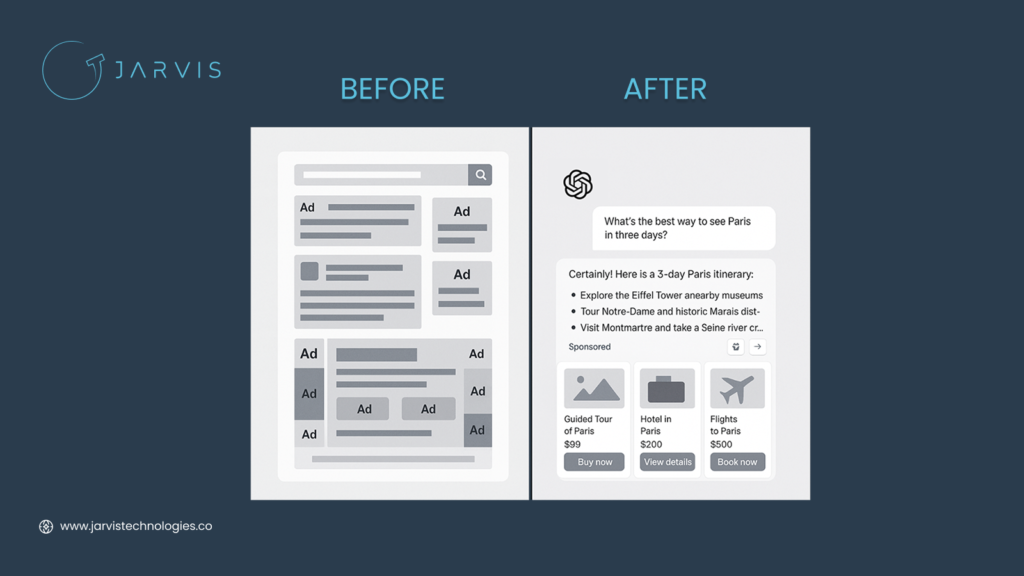
From what we know so far, here’s how ChatGPT Ads will appear inside ChatGPT:
🔹At the bottom of responses: after ChatGPT has delivered its answer.
🔹Clearly labeled and separate: users can tell it’s an ad.
🔹Contextual relevance: aligned with the topic of your conversation.
🔹User control: users can disable ad personalisation or clear data used for ads.
🔹Ad-free zones: ads will not show for topics like health, mental health, politics, or other sensitive areas.
🔹No ads for people under 18: a crucial safety measure.
Think of it like a new type of intent-driven advertising, where the context of what someone is asking, not just profile data, dictates what ad they see.
This is different from traditional social media ads or search ads, and it opens up interesting possibilities (and challenges) for how marketers think about relevance and placement.
What It Means for Marketers and Brands
Now let’s talk about why this is exciting and strategic for businesses.
🔹 A brand-new advertising channel
ChatGPT reaches hundreds of millions of people every week. That’s a massive audience that’s engaged in real conversations not just scrolling feeds or browsing search results.
🔹 Contextual intent = high relevance
Ads shown after AI responses are highly contextual. A user who just asked about project management tools might see relevant software ads which can mean higher intent than typical display ads.
🔹 A different kind of search behavior
Users are moving from searching text to dialogue-based queries. For brands, this means thinking beyond keywords and understanding how people ask questions and what solutions they seek inside conversations.
🔹 Ad experience matters more than ever
Because ads are contextually linked to chats, marketers must think about relevance, usefulness, and user experience, not just clicks.
What Marketers Should Do Next
As marketers, especially those focused on digital strategy, this development is an opportunity to adapt early. Here’s what we recommend:
1. Study Conversational Intent
Begin thinking about how customers use language when they ask questions, not just when they search on Google. ChatGPT ads respond to intent inside a conversation and that’s different.
2. Create Useful, Contextual Messaging
Ads in ChatGPT will be most effective when they are genuinely helpful and context-aligned with user problems.
3. Diversify Beyond Traditional Platforms
If you’ve relied on Google Search or Meta platforms for reach, ChatGPT ads introduce a new intent pathway that deserves exploration.
4. Monitor User Feedback and UX
One strength of this model is that users can dismiss ads and provide feedback. Track what resonates and what doesn’t to refine relevance over time.
5. Think Long-Term
Right now it’s a test, initially in the U.S. But this hints at where AI and advertising are headed. Early experimentation can position you ahead of the curve.
As marketers, moments like this shape a broader strategy. When new channels emerge, especially ones as widely used as ChatGPT, we have to ask:
“How do we meet customers in the moment of need, not just the moment of intent?”
This isn’t just a new ad slot — it’s a new form of discovery and decision-making.
Final Thoughts
The launch of ads in ChatGPT is a significant turning point in how AI platforms support sustainability while maintaining user trust. OpenAI’s approach as labelled advertising, privacy commitments, and user controls, shows that they are aware of the risks and rewards.
For marketers, this means:
✔ A new canvas for relevance-first advertising
✔ A shift in how we think about user intent
✔ Opportunities for early adopters
✔ A need to design messaging that fits conversation context
At Jarvis Technologies, we’re watching this closely not just as observers, but as strategists helping our clients adapt. If you’re already including AI in your workflow, this evolution is a chance to lead.
Stay tuned for more updates and if you want help planning your advertising strategy, we’d be glad to help.