
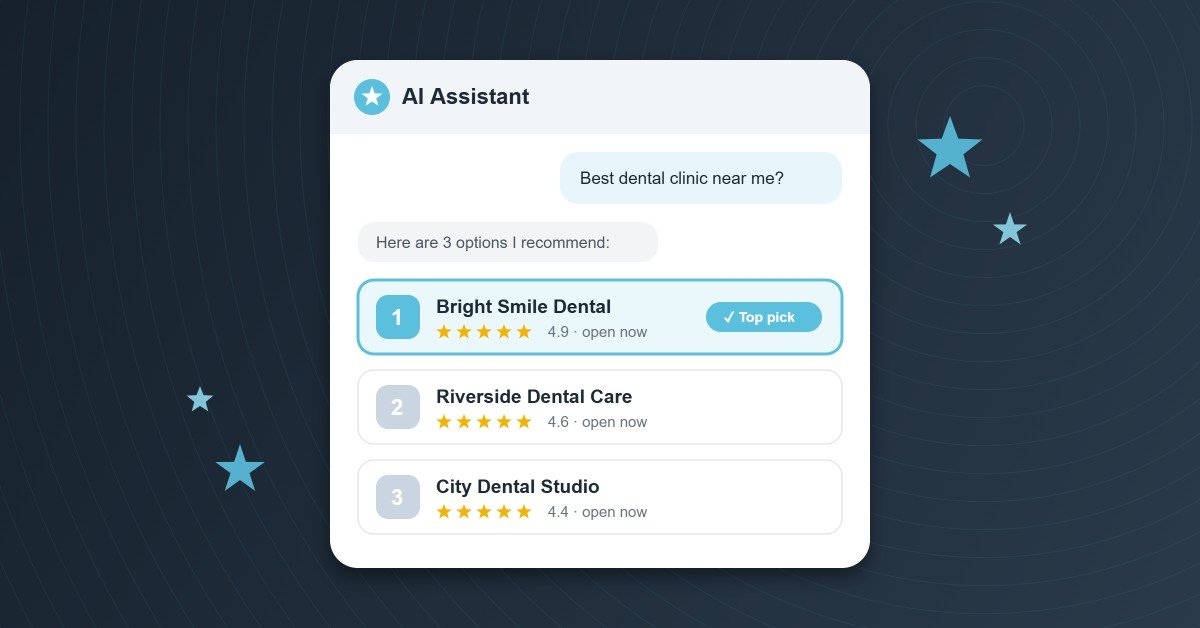

Short answer: AI assistants such as ChatGPT, Gemini, Perplexity and Google AI Mode recommend businesses they can find, understand and trust. To get recommended by AI, keep your business details identical everywhere they appear, collect recent reviews, publish pages that clearly answer your customers’ questions, earn mentions on trusted third-party sites and make sure AI search crawlers can read your website. You cannot pay for a fixed spot in an AI answer, and the list of recommended businesses changes from one answer to the next, so the goal is to appear often rather than to “rank first”.
Why AI recommendations now matter for UK businesses
Asking an AI assistant “who is the best dentist near me?” or “which accountant should I use for a small limited company?” has quickly become normal. BrightLocal’s 2026 Local Consumer Review Survey, based on 1,002 US adults, found that the share of people using ChatGPT or other AI tools for local business recommendations jumped from 6% to 45% in a year, making AI the third most used source after Google and Facebook.
UK data is thinner, but the early signs point the same way, and they are good news for smaller firms. In an August 2026 study, UK research bureau Whito asked Google AI Mode and Perplexity local buying questions about plumbers, accountants, dentists and estate agents. Of the 45 businesses named, 40 were independents. AI assistants are not simply picking the biggest brand. They pick the business whose information best answers the question.
How do AI assistants decide which businesses to recommend?
There is no single AI league table. When someone asks a question, the assistant works out what they need, gathers information from its search index and the wider web, then compares the options it finds. The businesses that come up most often usually share five things:
- Clear relevance: pages that state exactly what you do, who it is for and where you do it.
- Consistent facts: the same name, address, phone number and opening hours on your website, Google Business Profile, directories and social profiles. The SOCi Local Visibility Index 2026 found that only 68% of business contact details shown on ChatGPT and Perplexity matched the business’s Google Business Profile.
- Reputation: recent, detailed reviews across more than one platform, with replies from the business.
- Third-party mentions: coverage in local press, trade bodies, industry directories and “best of” articles that the AI can cite as evidence.
- Readable content: text that crawlers can access, rather than information locked inside images, PDFs or blocked pages.
Why AI recommendations change every time you ask
If you ask the same assistant the same question twice, you will often get a different list. Research by SparkToro and Gumshoe.ai ran 2,961 prompts through ChatGPT, Claude and Google’s AI tools and found that an identical list of recommendations came back less than 1% of the time. The order and the number of businesses changed too.
That changes how you should measure success. Being “number one in ChatGPT” is not a stable position. What you can track is how often your business appears across many versions of the questions your customers ask, and which sources the AI cites when it mentions you.
7 steps to get recommended by AI
1. Decide what you want to be recommended for
Write down the questions you want to be the answer to, using your customers’ words: service, location and type of customer. “Invisalign provider in Clapham” and “emergency dentist open Saturday in south London” are different questions, and each needs evidence on your site.
2. Make your business details identical everywhere
Audit your website footer and contact page, Google Business Profile, Apple Business Connect, Bing Places, Yell, trade directories and social profiles. Fix every mismatch in name, address, phone number, opening hours and services. Adding LocalBusiness structured data to your website gives search engines and AI tools a machine-readable version of the same facts. For the profile itself, follow our step-by-step guide on how to optimise Google Business Profile.
3. Build pages that answer questions directly
Each core service, and each area you serve, deserves its own page that answers the main question in the first few lines, followed by detail, pricing guidance or “contact us for a quote” wording, and an FAQ section. This is classic search optimisation, and it is exactly what AI tools draw on, which is why strong SEO services remain the foundation of AI visibility.
4. Earn reviews continuously and reply to them
Ask every satisfied customer for a review, spread across Google and at least one other platform relevant to your sector, such as Trustpilot or Doctify for clinics. Recent reviews that mention the specific service and location give AI assistants something concrete to repeat. Never buy or write fake reviews: the Digital Markets, Competition and Consumers Act 2024 makes them illegal in the UK.
5. Get mentioned on sites AI trusts
AI answers lean heavily on third-party sources. Local news features, trade association listings, supplier and partner pages, podcast appearances and expert comment in industry publications all help. Useful guides and data that other sites want to reference come from consistent content marketing, not one-off posts.
6. Check that AI crawlers can read your site
Review your robots.txt file and any firewall or CDN bot settings. Some security tools block AI search crawlers, such as OpenAI’s OAI-SearchBot or PerplexityBot, by default, which can keep your pages out of those answers entirely. Make sure important information is in plain HTML text, not only in images or downloadable PDFs.
7. Test, track and repeat every month
Each month, ask ChatGPT, Gemini, Perplexity and Google AI Mode the questions from step 1, several times each. Record whether you appear, which competitors appear and which sources are cited. In Google Analytics 4, track referral traffic from AI tools such as chatgpt.com and perplexity.ai. Over time, the sources the AI keeps citing show you where to focus.
What does not work
- Hiding keywords or instructions aimed at AI in page text. It can damage trust with both search engines and customers.
- Paying for fake reviews or mass directory listings on low-quality sites.
- Changing one platform and expecting instant results. AI tools refresh their information at different speeds, so consistent effort matters more than a single fix.
FAQs
Can I pay to be recommended by ChatGPT?
No. Organic recommendations in AI answers cannot be bought. Where AI platforms show advertising, it is labelled separately from the answer itself.
Does SEO still matter if customers use AI?
Yes. AI search tools rely on web content and search indexes to build their answers, so the same things that help you rank, such as clear pages, consistent business data, reviews and links from trusted sites, also make you easier for AI to recommend.
How long does it take to start appearing in AI answers?
It varies by platform and sector. Fixing inconsistent business details and gathering fresh reviews can make a difference within weeks, while building third-party mentions and authority takes months. No one can guarantee a recommendation.
Can small businesses compete with big brands in AI recommendations?
Yes. For local questions, AI assistants often name independent businesses because they match the location and service more closely than national brands. Clear, consistent and well-reviewed information matters more than size.
3 Comments
AI Will Kill SEO: Myth or Reality? | Jarvis Technologies
[…] answer engines. SEO is becoming visibility strategy. For a practical checklist, our guide on how to get recommended by AI walks through the […]
ChatGPT Is Launching Ads: What It Means for Marketers
[…] not just clicks. Paid placements will sit alongside organic answers, so it also pays to learn how to get recommended by AI without an ad […]
How to Optimise Your Google Business Profile (UK Guide 2026)
[…] marketing agency in London. And because the same signals now feed AI assistants, our guide on how to get recommended by AI is a useful next […]