
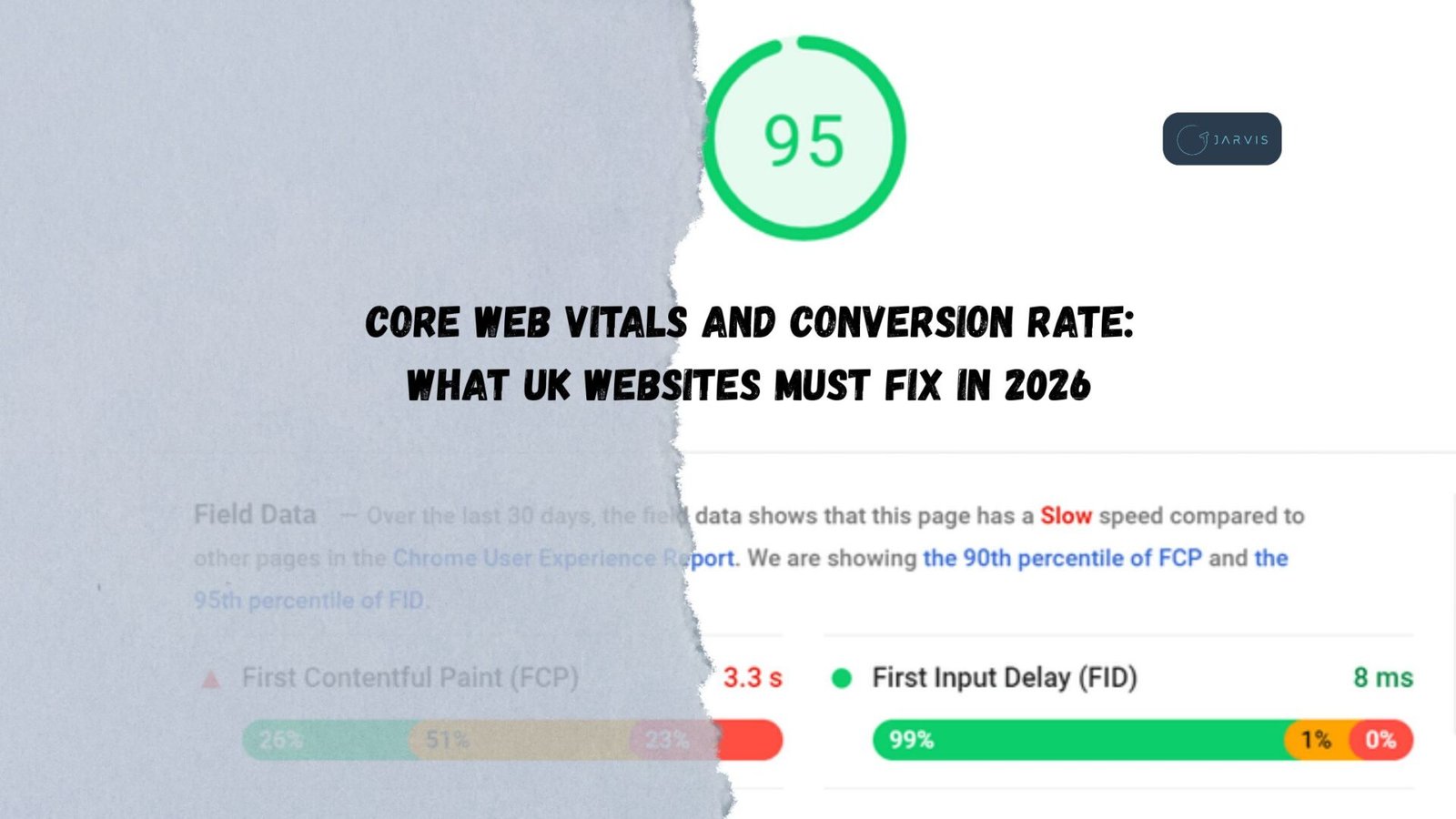

If your website has felt “fine” for the last year but your conversion rate has quietly slipped, Core Web Vitals is worth checking before you touch your ad spend or your copy. Google’s March 2026 core update changed how these metrics are scored, and the businesses that haven’t kept up are losing both rankings and revenue without necessarily realising why.
What Core Web Vitals Actually Measure
Three metrics, all based on real user data rather than lab tests: Largest Contentful Paint (LCP) measures how quickly your main content becomes visible, Interaction to Next Paint (INP) measures how responsive your site feels when someone clicks, taps or fills in a form, and Cumulative Layout Shift (CLS) measures whether your layout jumps around while loading. All three need to pass at the 75th percentile of real visitor sessions for your site to get a “good” rating.
What Changed in March 2026
Two things shifted the ground under UK site owners this year. First, Google tightened the “good” LCP threshold from 2.5 seconds down to 2.0 seconds, meaning sites that were previously passing comfortably can now fall into “needs improvement” without a single change on their end. Second, and more significantly, Google now assesses Core Web Vitals at a site-wide level rather than page by page — a handful of slow legacy pages can now drag down the ranking of pages that individually pass every threshold.
Industry analysis following the update found sites where more than a quarter of URLs fell into “poor” or “needs improvement” on any single metric saw their whole domain’s performance signal penalised, not just the affected pages.
The Revenue Case, in Real Numbers
This is where it stops being a technical checkbox and becomes a business conversation. Documented case studies are consistent: a well-known e-commerce optimisation study found that when a page loads in 1 second, average conversion rate sits near 40%; at 2 seconds it drops to 34%; at 3 seconds it settles around 29%. A one-second delay has been shown to cost roughly 7% in conversions and 11% in page views.
Real brand results back this up. One major retailer improved LCP and saw revenue per visitor rise by over 50% and conversion rate climb by roughly a third, from that single change. Another saw an 8% sales increase purely from cutting render-blocking JavaScript to improve load speed. A third improved INP responsiveness and saw mobile product page conversions more than double.
For context on where most sites currently stand: only around 56% of websites globally pass all three Core Web Vitals, and the gap is worse on mobile, where pass rates sit closer to 48–50% versus roughly 56–63% on desktop — despite mobile now driving the majority of UK web traffic.
Where UK Sites Are Losing the Most Ground
Mobile LCP is the biggest single problem. Heavy hero images, unoptimised product photography and render-blocking scripts routinely push mobile load times well past the new 2-second threshold, even on sites that look fast on a desktop connection.
INP is quietly owned by marketing tools, not developers. Tag managers, chat widgets, heatmap tools, consent banners and personalisation scripts all run JavaScript on the main thread, and that’s exactly what damages responsiveness. A fast-loading page with a stuttering “Add to Basket” button still fails.
Legacy pages nobody’s touched in years. Under the new site-wide scoring, an old landing page or forgotten blog template can now drag down pages that are otherwise performing well.
Fixing It Without a Full Rebuild
You don’t need to rebuild your website to make meaningful progress. Start with Google Search Console’s Core Web Vitals report to identify which templates are affected and prioritise by traffic and revenue value, not by what looks worst. For LCP, compress and properly size images (WebP format where possible), and consider whether your hosting is genuinely fast enough — cheap shared hosting is a common, underestimated culprit. For INP, audit every third-party script currently running and be ruthless about removing anything that isn’t earning its keep. For CLS, reserve space for images and dynamic content before they load, so nothing shifts as the page builds.
Don’t chase a perfect Lighthouse score of 100 — realistically, sitting comfortably in the “good” range across all three metrics matters far more than chasing a few extra points once you’re already passing.
The Bottom Line for UK Businesses
Core Web Vitals isn’t a ranking silver bullet on its own, and Google is explicit that a great page experience won’t rescue thin or irrelevant content. But it is a genuine, measurable drag on both visibility and revenue if you’re failing it — and for a UK business doing meaningful online revenue, even modest speed and responsiveness fixes tend to pay for themselves within weeks.
Frequently Asked Questions
What is a good Core Web Vitals score in 2026?
A page needs to pass all three metrics simultaneously at the 75th percentile of real user sessions: LCP at or under 2.0 seconds (tightened from 2.5s in March 2026), INP at or under 200 milliseconds, and CLS at or under 0.1.
Do Core Web Vitals actually affect Google rankings, or just user experience?
Both. Google treats Core Web Vitals as one ranking signal among many, not a guarantee of top rankings on their own — but sites with LCP above the “good” threshold have shown measurable position drops on competitive search terms, particularly after the March 2026 update.
Why did my website’s Core Web Vitals suddenly get worse without any changes?
This is usually the March 2026 threshold tightening (LCP’s “good” cutoff dropped from 2.5s to 2.0s) combined with the shift to site-wide scoring, where underperforming pages elsewhere on your domain can now pull down pages that individually haven’t changed.
How much can fixing Core Web Vitals actually improve my conversion rate?
Documented case studies show conversion rate improvements ranging from roughly 8% to over 30% following Core Web Vitals fixes, with the exact figure depending on how poor your starting performance was and which metric was the biggest bottleneck.
Is WordPress bad for Core Web Vitals compared to other platforms?
WordPress sites tend to underperform on mobile Core Web Vitals pass rates compared to platforms like Shopify or statically built sites, mainly due to plugin bloat and heavier JavaScript — though a well-optimised WordPress site with a lean theme and minimal plugins can still pass comfortably.